


Deep Learning with TensorFlow, Keras and TensorFlow.js
Deutsches Forschungszentrum für Künstliche Intelligenz
at any time
Record of Achievement
48 hours

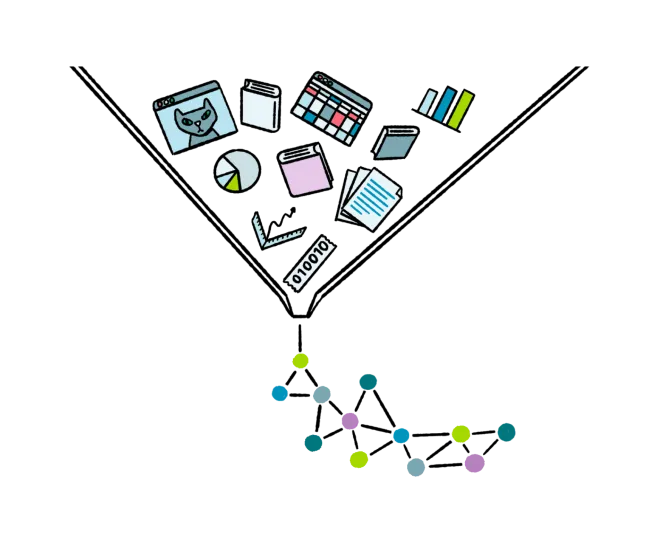
Machine Learning is a central subfield of artificial intelligence. Many digital applications in our daily lives use machine learning: spam filters sort out unwanted emails, streaming services recommend suitable content, and voice assistants respond to spoken requests. In all these cases, the systems use large amounts of data to recognise patterns and derive decisions from them.
Discover now on the AI Campus how different algorithms and learning methods work, what they are suitable for, and how you can use them in a targeted way.


Prof. Abhinav Valada, a full professor at the University of Freiburg. He directs the Robot Learning Lab. His research lies at the intersection of robotics, machine learning, and computer vision with a focus on tackling fundamental robot perception, state estimation, and planning problems to enable robots to operate reliably in complex and diverse domains.

Frank Hutter is a Full Professor for Machine Learning at the University of Freiburg (Germany), as well as Chief Expert AutoML at the Bosch Center for Artificial Intelligence. Frank holds a PhD from the University of British Columbia (UBC, 2009) and a Diplom (eq. MSc) from TU Darmstadt (2004). He received the 2010 CAIAC doctoral dissertation award for the best thesis in AI in Canada, and with his coauthors, several best paper awards and prizes in international competitions on machine learning, SAT solving, and AI planning. He is a Fellow of EurAI and ELLIS, the director of the ELLIS unit Freiburg and the recipient of 3 ERC grants. Frank is best known for his research on automated machine learning (AutoML), including neural architecture search and efficient hyperparameter optimization. He co-authored the first book on AutoML and the prominent AutoML tools Auto-WEKA, Auto-sklearn and Auto-PyTorch, won the first two AutoML challenges with his team, co-organized the ICML workshop series on AutoML every year 2014-2021, has been the general chair of the inaugural AutoML conference 2022 and is general chair again in 2023.

Stephan Scheele is Professor of Theoretical Computer Science and Artificial Intelligence at OTH Regensburg. Previously, he was Senior Scientist and Deputy Group Leader of the "Comprehensible Artificial Intelligence" project group at Fraunhofer IIS in Erlangen, as well as a postdoc at the Chair of Cognitive Systems under Prof. Ute Schmid at the University of Bamberg. He studied Business Informatics (Diploma, TH Deggendorf) and Computer Science (M.Sc., University of Ulm), and received his PhD in Bamberg in 2015 on constructive description logics in knowledge representation. He then worked for several years as Lead Software Architect at Robert Bosch GmbH in Renningen. His research focuses are knowledge representation, neuro-symbolic AI, as well as hybrid and explainable methods for trustworthy AI systems.

Bernd Bischl holds the chair of Statistics and Data Science at the Department of Statistics at the Ludwig-Maximilians-University Munich and is a co-director of the Munich Center for Machine Learning (MCML), one of Germany’s national competence centers for Machine Learning (ML). He studied Computer Science, Artificial Intelligence and Data Sciences in Hamburg, Edinburgh and Dortmund and obtained his Ph.D from Dortmund Technical University in 2013 with a thesis on “Model and Algorithm Selection in Statistical Learning and Optimization”. His research interests include AutoML, model selection, interpretable ML, as well as the development of statistical software. He is a member of ELLIS in general, and a faculty member of ELLIS Munich, an active developer of several R-packages, leads the mlr (Machine Learning in R) engineering group and is co-founder of the science platform OpenML for open and reproducible ML. Furthermore, he leads the Munich branch of the ADA Lovelace Center for Analytics, Data & Application, i.e. a new type of research infrastructure to support businesses in Bavaria, especially in the SME sector.

Dr. Alassane Ndiaye has been a senior software engineer (R&D) and project manager at the German Research Center for Artificial Intelligence (DFKI) for more than 20 years, working on research as well as industry and transfer projects. Among other things, he uses machine learning in forecasting methods for the energy industry and electromobility.

Dr Matthieu Deru is a senior software engineer (R&D) and UX designer for interactive systems at the German Research Center for Artificial Intelligence GmbH (DFKI). His project experience covers topics as diverse as the application fields of AI, from intelligent user interfaces to complex prediction models for electromobility.

Ute Schmid holds the Chair of Cognitive Systems at the University of Bamberg. For more than 20 years, she has been teaching and conducting research in the field of Artificial Intelligence. From 2020 to 2025, she led the Fraunhofer IIS Comprehensible AI project group. She heads the SME AI Experience Centre, funded by the Bavarian Ministry of Economic Affairs, and is a member of the board of directors at the Bavarian Research Institute for Digital Transformation (bidt). Ute Schmid is internationally recognised in the areas of human-like machine learning, neuro-symbolic AI and explainable machine learning. She also conducts research in the field of AI and education. In addition to a degree in Computer Science, she has also obtained a degree in Psychology and has many years of experience in empirical research.