
In 6 steps to customised blended learning formats – a use case from DHBW Heilbronn




The AI Campus partner platform offers lecturers the opportunity to assemble individual and target group-oriented learning opportunities from the entire AI Campus portfolio. We demonstrate how this works using the example of a course on AI in academic work. With this course, AI competences have been effectively integrated into key qualifications at DHBW.
What is the AI Campus partner platform?
The AI Campus does not just offer a range of publicly accessible learning materials on artificial intelligence for all those interested. With the so-called partner platform, an additional offering especially for lecturers has been created some time ago. This enables them to combine existing materials into individual, target group-oriented courses and embed them into an overall didactic concept by adapting materials or supplementing them with their own content, such as interactive H5P elements.
The created modules or courses can be integrated into learning management systems such as Moodle or ILIAS via an LTI interface. Learning Tools Interoperability (LTI) is a specification developed by the IMS Global Learning Consortium. It provides a standard for integrating learning applications into learning platforms.
The approach at DHBW Heilbronn
As part of the AI Campus Hub Baden-Württemberg, the AI team at DHBW Heilbronn has created a range of learning opportunities for different target groups on the partner platform, including courses for DHBW administration staff, for lecturers, and for students from various degree programmes. These previously created courses are also freely available to all registered lecturers.
In this blog post, we want to use our course on academic work with AI as an example to illustrate the steps required to create a course or module that suits your needs. Our course "Academic Work with AI" was run in the winter semester 2025/26 in cooperation with the Competence Centre for Academic Work at DHBW, involving over 600 students, using a blended learning concept across various degree courses and semesters. The assessment of competences at the beginning and end of the course showed that AI competences improved significantly in some areas, for example regarding a positive attitude and confident handling of AI, as well as increased awareness of potential bias and discrimination in AI-generated outputs.
The following diagram shows the six process steps from developing the course concept through to evaluation.
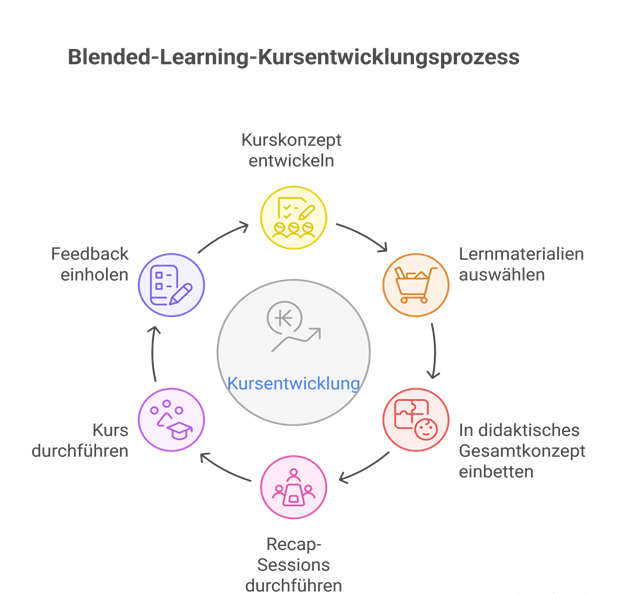
1. Developing a course concept
As the content foundation of the blended learning concept, an online self-study course was initially designed and implemented on the AI Campus partner platform. The first step involved defining target group-specific learning objectives—in this case for students—based on the AI competences model of the Bertelsmann Stiftung. On this basis, a coherent didactic course concept was developed. The course, "Academic Work with AI", developed at the Baden-Württemberg Cooperative State University (DHBW), addresses all seven competence dimensions of the AI competences model, with a particular emphasis on those AI competences deemed central to the university context, especially legal, ethical, as well as application-oriented skills.
2. Selecting learning materials on the AI Campus partner platform
Starting from the defined learning objectives, thematically relevant courses on the AI Campus partner platform were systematically analysed and suitable learning materials (e.g. videos, texts, self-tests) were integrated into a newly created course using the so-called "Sharing Cart" function, which serves as a central clipboard, and didactically assigned to the relevant modules. For example, the "Academic Work with AI" course consists of three compulsory modules: fundamentals of artificial intelligence, ethical and legal issues, and the application of AI in studies, each concluding with a short survey. In addition, optional in-depth modules are offered for students to set individual focuses.
Parallel to this selection and integration process, the course concept is continually adapted to the available materials and iteratively further developed.
3. Embedding in an overall didactic concept
The selected learning content was subsequently embedded in a coherent learning arrangement through structuring elements—including standardised module introductions and completions, final tests, and reflection tasks. These structuring elements are based on so-called scaffolding principles: module introductions activate prior knowledge and set expectations, while reflection tasks encourage transfer into one's own study context.
The module introductions are designed to actively involve students, for example through targeted questioning of prior knowledge and individual assessments. In this way, existing knowledge is connected, subject understanding is deepened, and interest in subsequent learning content is promoted. In addition, application-oriented task formats such as reflection tasks, exercises, and self-tests were integrated after individual learning units, serving to consolidate and secure knowledge.
Here, the AI Campus partner platform offers a wide range of design and extension options, including the creation and integration of additional materials such as texts, images, videos, interactive H5P elements, or tests.
The course thus conceived is made available to DHBW students on their familiar learning platform (Moodle). The technical connection is made using the LTI interface.
4. Recap session on-site or online
As part of the blended learning concept, it was important to us to offer students an opportunity to deepen the content. Therefore, the self-study course was integrated into the "Academic Work" teaching event. In so-called "Recaps", lasting 2x2 or 1x4 teaching units (UE), which were conducted synchronously either on-site or online depending on the lecturer's preference, the focus was placed on in-depth elements that are only partially realisable in the online self-study units: cooperation, communication, interaction, and reflection.
Overall, the developed concept enables an interactive design of teaching and learning arrangements through a varied mix of methods and social forms, combining individual, partner and group work phases. In this way, students' critical reflection skills are especially promoted through targeted discussion prompts.
To activate prior knowledge and gain individual perspectives, visual prompts and digital survey tools such as Mentimeter were used (e.g. "Which AI tools do you use in your studies?" or "Which content from modules 1–2 surprised you most?"). The results served as a basis for joint reflection in plenary.
Additionally, playful competition formats were used, for instance to compare and evaluate different prompting strategies. A creative task particularly well received by students involved a short presentation of selected AI tools as part of a pitch, developed in pairs or small groups. Besides activating students and fostering presentation skills, this format offers the added benefit that practice-oriented information and up-to-date application tips are contributed from the students' own perspective.
The results developed during the teaching event were documented on a prepared Miro board, which remains available to students beyond the end of the course as a tool for securing and following up results.
5. Course delivery
This blended learning format has now been implemented by the AI team in a number of courses at various DHBW locations, either in person or online. Through this direct integration into various degree programmes, over 660 students most recently completed the curated course as part of the blended learning format. Currently, a train-the-trainer programme is being developed to train lecturers directly for course delivery and further increase its reach. The integration of the self-study course into an existing degree offering has been helpful in achieving acceptance and implementation.
6. Gathering feedback and improving courses
At the end of each course run, students' learning progress was recorded and anonymous feedback on the course concept was collected. This feedback is continually analysed and used for the iterative further development of the course and recap concept, which has now been continuously optimised for over two semesters and has already been adopted by several professors and lecturers. In addition, at the end of the course, reference is made to the “AIssessment” developed at DHBW Heilbronn, through which students can assess their individual level of AI competences and receive targeted advice on closing identified competence gaps.
Opportunities and challenges
The partner platform offers an excellent opportunity to compile existing AI Campus learning materials in a target group-oriented and individualised way and to prepare them in line with one's own time and content requirements.
The advantages of a wide selection of freely accessible, high-quality, and up-to-date (OER) learning materials are obvious. However, when creating independently assembled courses, some challenges arise that should be borne in mind:
- The selection and variety of learning materials available on the AI Campus is extremely large, making thorough review very time-consuming. Careful documentation can be helpful here.
- The content is not always standardised in terms of design, level, or approach to target groups, so post-processing may be required.
- The selected elements must be embedded in a meaningful overall didactic concept. Lecturers often lack the time resources to undertake this process themselves.
Uncertainties in handling AI content could deter some lecturers from creating and implementing courses independently. This is where well-prepared basic materials come in, and particularly in the area of basics, enable a low-threshold entry. At DHBW Heilbronn, these challenges could be addressed by the cross-disciplinary AI team, which took over the creation of the courses and delivery of blended learning formats, thereby relieving lecturers of time and content burdens. Thanks to the partner platform, the AI team was able to reach several hundred students, lecturers, and staff with target group-specific courses and sustainably expand their AI competences. In our experience, the AI Campus with its partner platform provides lecturers with a powerful OER platform that can effectively support the development of sustainable, scalable, and high-quality AI qualification opportunities in the university context.

Laura Boulard is a research assistant at DHBW Heilbronn and part of the AI team there. She also works as a secondary school teacher, teaching English, philosophy and French in Hamburg.

Dr Britta Lintfert heads up educational research with a focus on AI at DHBW Heilbronn and is responsible for developing AI courses and concepts and integrating them into the DHBW curriculum. She holds a doctorate in linguistics.

Milena Stegner is a research assistant in educational research at DHBW Heilbronn as part of the project ‘Strengthening AI Skills at Universities’. As part of the AI team, she is primarily responsible for developing target-group-oriented AI campus learning formats for students, lecturers and staff. In addition, she is completing her PhD on chatbots as friends at the University of Freiburg and works as a freelance trainer and AI lecturer.

Julia Thomale is a research assistant at DHBW Heilbronn. As part of the AI team, she is responsible for developing AI courses for students, teachers and staff.