
AI Campus Wrapped 2025: Our most popular online courses



What were the top courses on the AI Campus in 2025? In our best-of, we reveal which new highlights and long-standing favourites have particularly inspired you.
2025 was again an eventful year for the entire AI world and of course for us at the AI Campus. By the end of the year, around 125,000 learners were registered on the platform. With over 60,000 certificates issued, the number of achievement records earned since the start of the year has even tripled. This shows how intensively you have used our learning opportunities and further developed your AI competences.
In the best-of 2025, we take a look at which new online courses and which AI Campus classics were the most successful in terms of enrolment numbers.
The Rising Stars of the Year
Which new courses managed to reach particularly many learners in 2025? These five learning opportunities attracted the most sign-ups in the very year of their release:
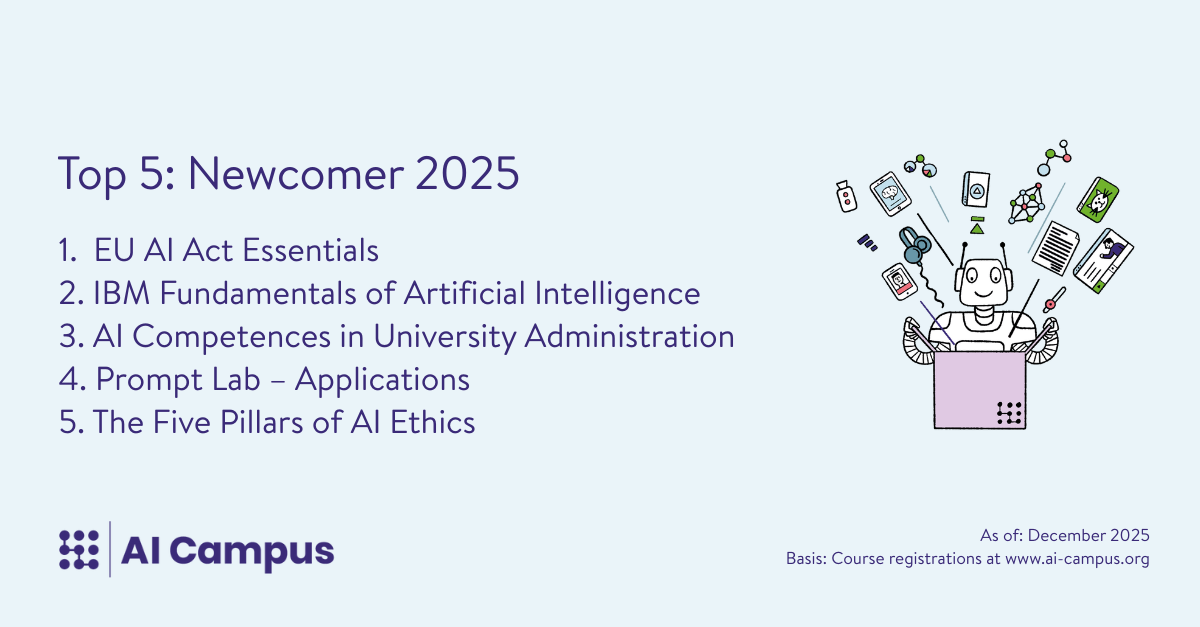
1. EU AI Act Essentials
The EU AI Act has decisively shaped the AI year 2025. Since February, binding requirements for the development of AI competences (Article 4) have applied to everyone involved in developing, operating or using AI systems. It is no wonder then that our course on the AI Act is the top newcomer of 2025!
‘EU AI Act Essentials’ by the appliedAI Institute for Europe and the Technical University of Munich imparts the main terms, requirements and objectives of the new regulation. Interactive content and practice-based examples show how the AI Act is being implemented in administration, healthcare and education. The course is aimed at teaching staff and students at higher education institutions as well as professionals wanting to understand the legal framework.
2. IBM Fundamentals of Artificial Intelligence
The IBM SkillsBuild fundamentals series is aimed at anyone looking for a concise introduction. Even the first course in the series offers, in less than two hours, a structured overview of the development of AI, core technologies and typical areas of application. Clear examples illustrate where AI encounters us in everyday life today. This crisp implementation of ‘AI in a nutshell’ won you over.
Those who complete all six courses in the series will receive, in addition to the individual certificates, a Micro-Degree from IBM and the AI Campus!
3. AI Competences in University Administration
While AI is already firmly established in study and teaching, the need for solid competences is also growing in university administration, as our third place demonstrates.
In this course from Stifterverband and KDU.NRW, administrative staff discover which AI competences they need, which tasks can be handled more efficiently with AI, and which workflows help to fully exploit AI potential.
4. Prompt Lab – Generative AI in Higher Education: Applications
The topic of generative AI continued to shape discussions around Artificial Intelligence in 2025. Hardly a week went by without a new AI tool or an improved language model being introduced. For members of higher education institutions it remains challenging to keep an overview and to identify the right use cases for their work.
The new instalment of the popular Prompt Lab, from the AI Campus and the Hochschulforum Digitalisierung, provides a remedy by focusing on very concrete applications of GenAI. Lecturers from RWTH Aachen, Karlsruhe Institute of Technology (KIT), RheinMain University of Applied Sciences, and Bielefeld University share their tips on image generation, information visualisation and academic writing.
5. The Five Pillars of AI Ethics
Fifth place among the newcomers also goes to a course from the IBM Fundamentals series, which deals with the exciting topic of AI ethics. It presents the five pillars of AI ethics: fairness, robustness, explainability, transparency and data protection. In the course, you can find out how AI ethics are implemented.
The further courses in the series cover topics such as machine learning, natural language processing, and AI in the labour market. It is certainly worth sticking with it.
Long-running Favourites on the AI Campus
Apart from the exciting newcomers of 2025, we also wanted to know which courses you have liked best since the launch of the AI Campus. These five “All-Time Favourites” count among the most popular classics on our learning platform:
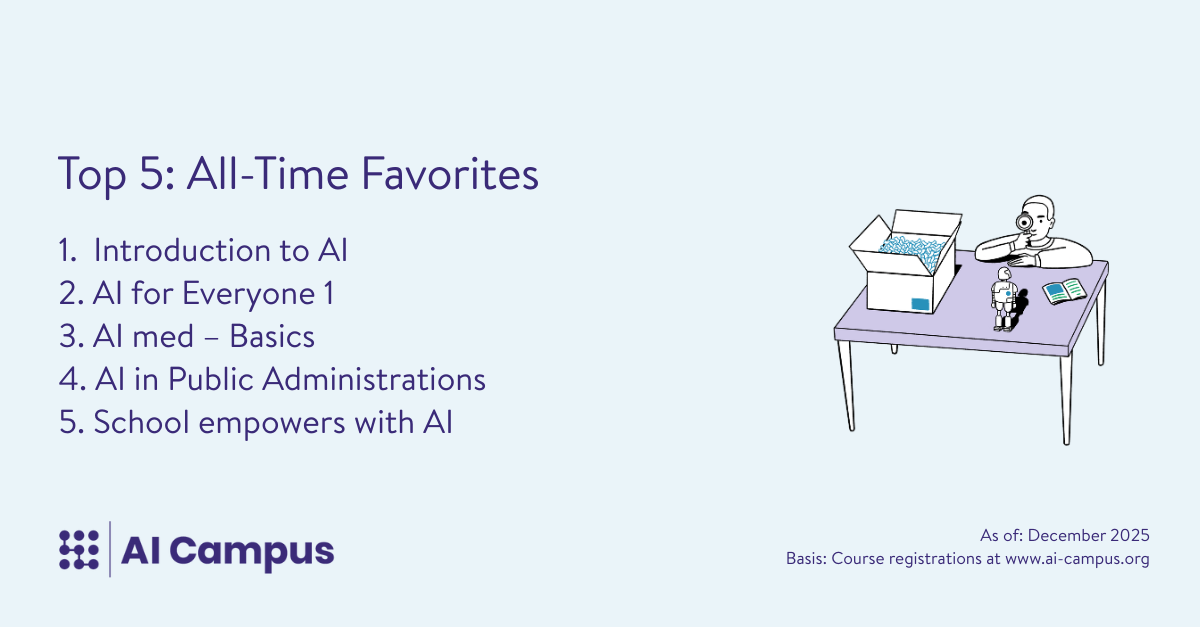
1. Introduction to AI
The introductory course "Introduction to AI" by appliedAI has been one of the most widely used learning opportunities for years – and for good reason: it provides a low-threshold explanation of the basic functioning of AI and machine learning and puts their social significance into context.
As well as the technical fundamentals, the course also discusses the opportunities, risks and the responsible use of AI. The course helps to better understand AI applications in everyday life and work.
2. AI for Everyone 1
"AI for Everyone 1", from the Heine Center for Artificial Intelligence and Data Science (HeiCAD), also provides a low-threshold yet comprehensive introduction to the world of AI.
After an introduction to the basics and history of AI, learners gain their first hands-on experiences. Using Jupyter Notebooks, basic programming skills in Python are taught. The course is supplemented by ethical, legal and application-related perspectives.
3. AI med – Basics
Artificial intelligence is playing an ever greater role in medicine, from diagnosis through to therapy. The basic course in the “Dr. AI” series from Charité and Stifterverband provides an accessible overview of these developments.
In addition to technical basics, the course also addresses data quality, ethics and legal issues. The course is even used in medical training, but is deliberately designed to be easily understood even without prior medical knowledge.
4. AI in Public Administrations
The course "AI in Public Administrations" shows how AI can be used specifically to modernise governmental processes. The University of Lübeck and MACH AG use practical examples to illustrate which potentials and challenges must be considered when using AI, machine learning and natural language processing in the public sector.
Many public institutions already use this course for strategic competence development and rely on the AI Campus as a reliable further education partner.
5. School empowers with AI
Another perennial favourite is “School Makes AI” – a course aimed specifically at teachers and student teachers. In a short time, it covers the basics of AI and machine learning and introduces didactic approaches for teaching.
Junge Tüftler and Fraunhofer IAIS show how AI applications can be explained and critically examined. A particular focus is placed on dealing critically and confidently with AI tools in pupils’ everyday lives.
The Learning Year 2025 From the Perspective of AI
Based on the most popular courses, a popular generative AI chatbot came to the following conclusion when we asked:
Learners on the AI Campus in 2025 are especially practice-oriented, responsible, and interdisciplinary. They are interested not only in technical fundamentals, but also in ethical, legal, and societal questions around artificial intelligence. Notably, there is also a strong interest in concrete application scenarios – especially in education, administration and health.
In short: AI is not just understood, but reflected upon and used purposefully.
We'll leave it at that for now and sincerely thank you for your willingness to learn!
Was your favourite course included?
Once again this year, we thoroughly enjoyed seeing which topics and online courses interested you the most. Perhaps your favourite course was among the best-of, or you found inspiration for your next learning step on the AI Campus.
And there will be plenty of exciting new content to look forward to in 2026 – that much we can already reveal. Stay tuned!

Lucas Laux is responsible for public relations for the AI Campus and the ‘Future Skills & AI’ programme area at Stifterverband. He studied media studies at Humboldt University in Berlin (M.A.) and at the University of Passau (B.A.). Previously, he worked for several creative agencies in the field of PR and corporate communications. His focus is on topics at the intersection of technology, education and culture.

Lena Lawrence is the instructional designer and data scientist for the AI Campus project. After completing her master's degree in educational technology (M.Sc.) at Saarland University, she worked as a researcher in the field of learning science, focusing on learning analytics using eye tracking and physiological signals at Saarland University. During her research, she gained insights into the interplay of cognitive, emotional and social aspects in the learning process. She holds certifications from IBM (Data Science Professional) and DataCamp (Data Scientist).